Alberta expands Castle area parks, phasing out off-highway vehicles
-
Share on Facebook
-
Share on Bluesky
-
Share on X
- Copy Link
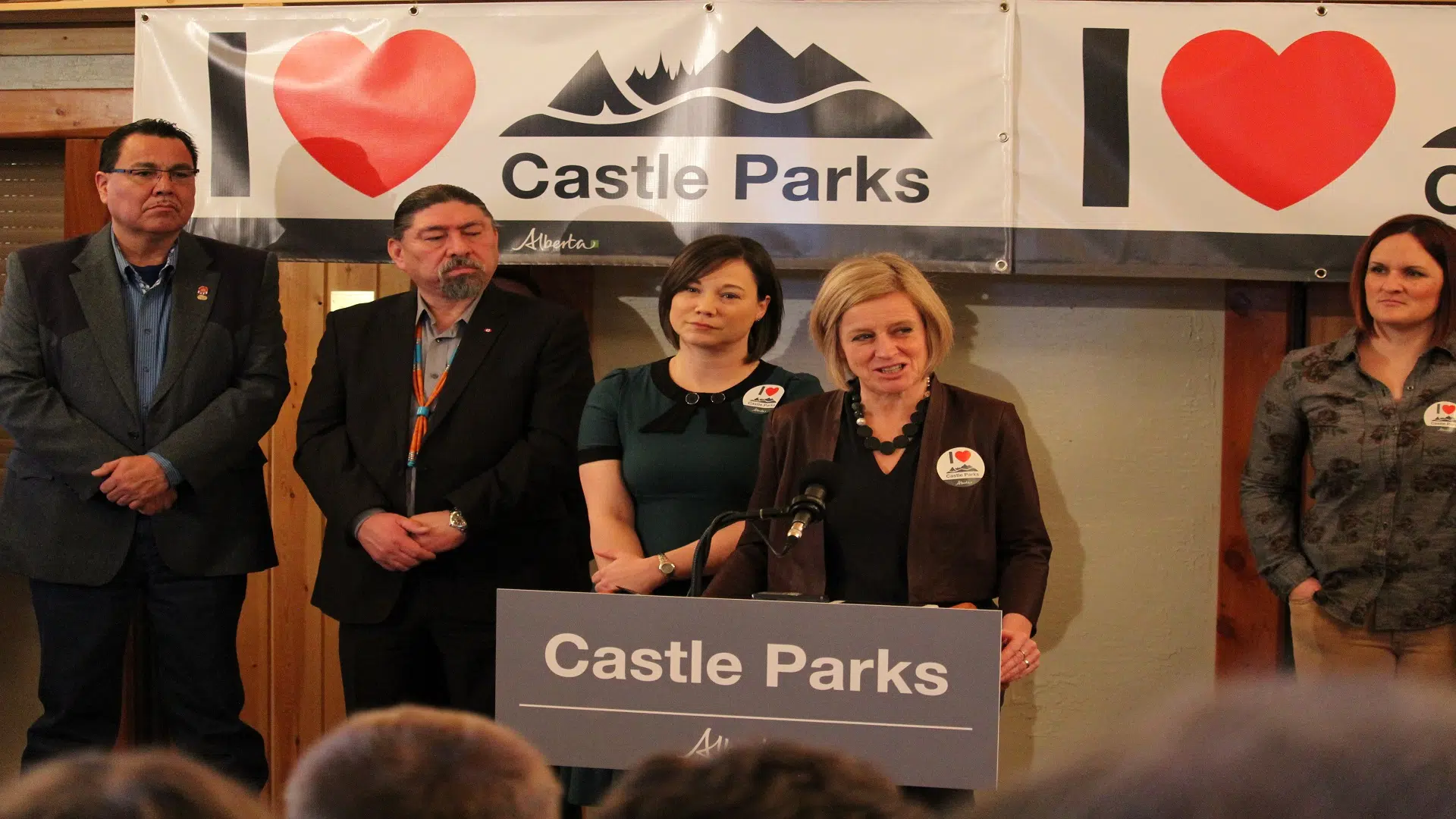
PINCHER CREEK – It was a mixture of applause and disgruntled boo’s at a provincial government announcement in Pincher Creek Friday (Jan. 20) morning.
Premier Rachel Notley was joined by Minister of Environment and Parks, Shannon Phillips, to announce that the boundaries have now been set for the expanded Castle Wildland Provincial Park and the new Castle Provincial Park, in order to protect one of Alberta’s most biologically diverse areas. In September 2015, the province shared its intentions to do so during an announcement event in Blairmore, after what Minister Phillips says was “nearly 40 years of scientists and environmentalists asking for protection of these parks.”
This means the government is also acting to phase out off-highway vehicles (OHV) over the next five years across the 103,000-hectare piece of land, which is home to over 200 rare and at-risk species. Existing OHV trails within the Castle parks will be assessed for ecological risks, while non-designated trails will be rehabilitated.
Phillips explained that the Alberta government is in full support of OHV activity, but would rather relocate trails from Castle to nearby public lands and invest in proper infrastructure to ensure that outdoor enthusiasts can continue to enjoy their sports in a way that sustains the environment over the long term.
“Wilderness areas are delicate and we have a responsibility and an obligation to protect them… Alberta has a government focused on preserving them for all time,” Premier Notley stressed during her announcement, amidst dissatisfied outbursts from the crowd. “Our plan is founded on the idea that Castle needs enhanced measures to keep its beauty intact.”
However, residents like Clint Riviere, who was raised near Pincher Creek and frequently enjoys the Castle area with his OHVs, came together at the announcement to express their disagreement with the government’s decision.
“There are rules and regulations in place, and, for the most part, they do their job,” Riviere stressed. “It’s like anything in society, there is people that are going to break the rules. But punish those people! Don’t punish the general population.”
Riviere went on to state that he was unhappy with what he felt was a lack of consultation with residents in the area. While he doesn’t agree with tearing up virgin trails, Riviere believes that existing trails should “be left alone”, and that more policing would be a better option.
The Castle area has cultural and historical significance for Indigenous people, as well, who will play a role in managing the parks.
“Why we’re here today is to applaud the announcement, and also ensure our interests are entrenched as we go forward in meaningful dialogue with the province of Alberta,” added Stanley Grier, Chief of the Piikani First Nations.
The Canadian Parks and Wilderness Society (CPAWS) and Yellowstone to Yukon Conservation Initiative (Y2Y) also praised the formal designation of the Castle Wildland and Provincial Parks, noting that its a major source of water in southern Alberta and an important habitat for a wide variety of plants and animals.
The next step for the province will be the development of a regional tourism strategy, a comprehensive management plan and the completion of priority planning for Porcupine Hills and Livingstone Range vacant public lands. Premier Notley stated that roughly 44 new jobs will be created in order to oversee and maintain the two parks, and will only come as another form of economic diversification.
A 60-day public consultation, funded from the normal parks budget, begins now that will help flesh out the new parks’ features and opportunities before any plans are finalized. A draft plan has already been developed in conjunction with key stakeholders, and Albertans are encouraged to participate and provide feedback.