
Stay informed with the LNN Daily Newsletter
(Photo: Dreamstime)

Pilot program in Claresholm aims to end cycle of domestic violence

Jan 30, 2022 | 6:05 AM

LETHBRIDGE, AB – Domestic abuse was in focus at a recent meeting of the Southern Alberta Council on Public Affairs (SACPA), with special guest speaker Nara Fedozzi.

Fedozzi is the program director with the Safe at Home program, which aims to break the cycle of domestic abuse across Canada, starting with a pilot project in southern Alberta.

(Video: Southern Alberta Council on Public Affairs)

According to a report from Statistics Canada, ‘Family Violence in Canada: A statistical profile, 2019’, there were 107,810 victims of police-reported intimate partner violence in 2019. That was an increase of 99,000 from 2018. That report can be accessed here.

Fedozzi noted that between March and September 2021, there was over 2,400 reported cases of domestic abuse in RCMP jurisdictions within southern Alberta.

She said that figure is “probably way higher because a lot of people do not report domestic abuse for various reasons, sometimes it can be related to [them being] ashamed, they don’t want to disclose personal matters, [are] afraid of how the community is going to see them and how they are going to be treated.”

Safe at Home is designed to be an alternative approach to helping families suffering from domestic violence and abuse, with a focus on healing the whole family.

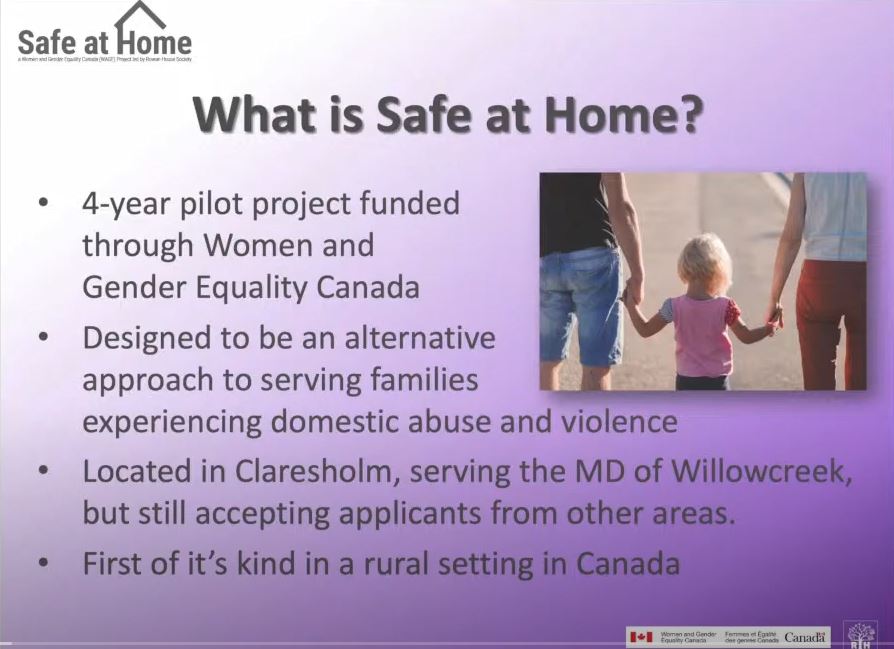
Typically, it is the woman and children who have to leave a situation of domestic violence. The Rowan House Society-led Safe at Home program is being piloted in Claresholm and is funded through Women and Gender Equality Canada.

Screenshot from Fedozzi’s presentation to SACPA.

As part of the program, the abuser leaves the home and receives counselling services at an off-site facility or independent living quarters, while the woman and children remain at home and work with outreach team members.

“That gives an opportunity for the person who has actually been impacted by the abuse to stay safe at home with minimal interruptions, or less interruptions to their day-to-day lives.”

For the purposes of the program, only men can stay at the Safe at Home counselling house, though Fedozzi recognized there are women who exhibit behaviours consistent with domestic violence.

She noted how important it is to talk about domestic violence, which can help reduce the number of reported, and unreported incidents of abuse.

She said, “there is a lot of stigma and myths about this topic, so I’m really hoping to continue this conversation, trying to normalize this topic, so more people can feel safe reaching out to supports and heal from [abuse].”

Fedozzi said staff working on the pilot will compile a document once the project is complete to share with other communities, to see if they would like to implement the Safe at Home program.

More details on the Safe at Home program are available here.