Stay informed with the LNN Daily Newsletter
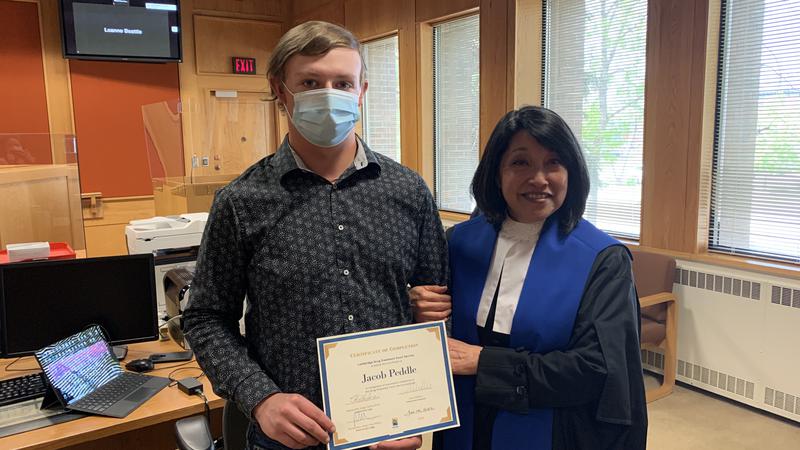
Jacob Peddle and Judge Sylvia Oishi at Lethbridge Drug Treatment Court graduation, June 1, 2022. (Photo:LNN)

Lethbridge Drug Treatment Court celebrates its first graduate

Jun 8, 2022 | 3:56 PM

LETHBRIDGE, AB – Jacob Peddle is the first to graduate from the Lethbridge Drug Treatment Court (LDTC) after about 18 months of recovery.

The LDTC offers eligible offenders with a substance use disorder (SUD) the opportunity to take part in a court-monitored drug treatment program as an alternative to incarceration.

On Wednesday, June 1, 2022, at the Lethbridge Courthouse, Peddle sat among family and friends for the ceremony.

Sylvia Oishi, the judge who presided over the first graduation ceremony of the LDTC, looked at Peddle briefly before scanning the crowd. She said this was not a typical scene in court, as her lips curled into a subtle smile.


Alisa Webber, a Counsel with the Public Prosecution Service of Canada, then stood up and declared that it was, indeed, a celebration.

“We often hear from graduates of other drug treatment courts that it would be easier just to do your time,” Webber said to LNN outside of the courthouse, explaining the courage, determination, and persistence required to complete a demanding and rigorous program.

“It’s always very inspiring when they come to this point, and it really leaves me, in my role as a prosecutor, without a doubt that their rehabilitation has been really tested and demonstrated,” said Webber.

READ MORE: Lethbridge’s drug treatment court celebrates one year of success stories

The type of support a person receives through the LDTC program varies and will depend on the situation of each participant. Supports can include detox services, counseling, parenting classes, job skills training, and help finding stable housing.

Participants will also have to regularly update the court on their progress. Those without progress in their treatment could face consequences, which could include light or strict conditions.

Peddle says this program was exactly what he needed to overcome years of meth addiction, which almost ruined his life.

“I lost everything,” says Peddle, explaining he was also hostile and aggressive during his years of addiction. “Drugs absolutely ruined my life.”

Peddle’s life changed forever on a certain Sunday evening, when he was on his way home for dinner on Easter Sunday in April 2020.

Peddle was pulled over by police officers and charged with possession for the purpose of trafficking both cocaine and methamphetamine.

READ MORE: Weekend traffic stop in Claresholm results in drug charges

As an alternative to incarceration, Peddle was offered the opportunity to take part in the LDTC.

Webber says Peddle was reluctant to participate at first.

“When Jacob first came before the court and entered the program [and] entered his guilty pleas, I think he wasn’t necessarily thrilled about being there, but [he] was motivated in part about the option of avoiding a jail sentence,” Webber says with a light laugh, “And probably a little scared about what laid ahead.”

“I was terrified,” says Peddle, explaining he was only 18 years old at the time of his arrest. “I didn’t wanna go to jail.”

He says he likely would have gone to jail for approximately two years without the drug treatment court.

Peddle says he looked at the program as an opportunity to better himself, and he also admitted that it was a better alternative than going to jail and sitting on his own thoughts.

He says he also felt a little spark of hope within himself. He knew he was better than his addiction and that he could achieve and obtain so much more success in life than he ever could as an addict.

He recalls telling himself, “If I’m going to be better and be the man I’m supposed to be, this is how I’m going to have to do it.”

If Peddle was unable to complete the drug treatment court program, he would be sentenced to time in custody as per normal procedures.

Although Peddle chose to enter a guilty plea and join the program, it was not an easy road, but a path filled with thorns.

“I had to move out of my hometown, which I had never done before,” Peddle says, explaining that he had to leave his family and friends behind, and start over in Lethbridge where he knew no one.

The process of recovery, according to Peddle, was also extremely difficult, especially in the beginning. He says even the easiest days were much harder than any single day in addiction.

“You have to be 100% committed at all times and not lose motivation,” says Peddle. “Even in your hardest times and in the most difficult moments, you have to keep going, and if you don’t, then you’re not going to succeed.”

Peddle admits that recovery was easier when he was not allowed to go back home, because if he did, it would have been harder to walk away.

“My biggest challenge was to abide by that [LDTC] condition and not breach, and just go back to my hometown,” says Peddle. “I know how badly my kids need a dad. I know how badly my wife needs a husband, and I know how badly my family needs me as their son and brother.”

He also says the path to recovery does not mean someone has to fight alone.

“You can’t do this alone, and it’s honestly super hard in life to do anything alone or accomplish any of your goals by yourself,” says Peddle. “Even if you know to some extent that you’re doing a good job, for you to actually believe it, in some cases, it needs to come from other people.”

However, he also believes that validation needs to come from external sources as well as from yourself.

“It’s super important to have that connection, and not just seek assurance and validation from others, but also give that out freely,” Peddle adds. “As not only just an addict, or a man or a woman or anything – just as people, we all need assurance, reassurance, and validation in life.”

Peddle used his own advice to help other people during the program.

Peddle met Armande Good Rider during his recovery, who became one of his best friends, and came to support him at his graduation. Good Rider was also the first participant in Lethbridge’s drug treatment court.

Good Rider was arrested May 11, 2020 on multiple drug charges.

READ MORE: Two charged following bust at south Lethbridge hotel.

Similar to Peddle, Good Rider also had to block out everyone he knew who was associated with addiction, drug dealing, or other crimes. Good Rider says that affected a lot of his relationships. Prior to his arrest, Good Rider says he was a violent person who also suffered from depression, and he attempted to commit suicide multiple times.

Good Rider, just like Peddle, took part in the LDTC program as an opportunity to change himself, but he was skeptical in the beginning.

“I thought it was a trap,” says Good Rider. “They said, ‘plead guilty in court,’ right? And I was like, ‘I’m the first participant.'”

“I was like, ‘I don’t believe this. They’re probably gonna make me plead guilty, then put the handcuffs on me and send me away,'” he says. “Then I met him [Peddle] and then [he] made it a little easier through the program.”

“We talked s— about the program together,” Good Rider says with a laugh, “because obviously, we were still in early recovery.”

Good Rider says that he and Peddle grew together and they learned and supported each other. If either of them needed improvement in a certain area, they would offer suggestions to one another.

“He’s like a brother to me,” says Good Rider. “He’ll see that I’m going through a hard time, and he’ll be there to talk to me. Me and him were with each other. We helped each other throughout the whole program, through his ups and downs, and my ups and downs.”

“It shocks me that such a young man can teach me so much,” says Good Rider, admitting that he admires Peddle for showing the people of Lethbridge and Claresholm that people struggling with addiction are not all bad people.

“We actually have a heart,” says Good Rider. “We just need that guidance to be held accountable, and to be shown a different way in life, and to find our own path.”

Good Rider also believes that breaking the cycle of addiction is very hard. “[It’s] sad to say that a lot of people don’t make it. I lost 11 people last year – close families of mine.”

“The fact that Jacob got out of it and showed his family,” says Good Rider, “it’s very hard to break that cycle.”

“People on the outside may look at this as a little thing [and say] ‘Oh, he’s gonna go back,'” says Good Rider. “He’s the youngest, and [yet] he’s the leader of this program. He’s shown us all we can do it, and people on the outside don’t believe it. [But] everyone in this program [will] continuously show the city that we are able to change.”

According to Peddle and Good Rider, Lethbridge’s Drug Treatment Court was a positive experience in their respective journeys.

Peddle says the support system in the program is “honestly astounding.” He says the program has different areas of support, ranging from legal and addiction support, to simply needing a friend to go have a coffee with.

On the other hand, while Good Rider encourages new participants to give the program a chance, he warns that drug treatment courts are only helpful if participants are truly ready to change.

“If you’re not ready for the change and this is your one chance to change it, and you mess it up,” he says, “you’re not gonna take that chance again. Your last chance is just jail. So, join the program when you’re ready.”

Good Rider is expecting to graduate soon. He is excited to start a new life with his family upon graduation.

“My view on courthouses were like, ‘F that place.’ And now, honestly, I love this place. I’m gonna miss this place when I graduate,” said Good Rider. “I’m kind of getting like a bittersweet thing where I’m gonna miss it, but at the same time, I’m glad I finished it, you know, because it was extremely hard. One of the hardest things that I’ve had to do in my life.”

Meanwhile, Peddle, who is the first graduate of the Lethbridge Drug Treatment Court is finally able to go home after 18 months. “I’m going to be moving home and be with my wife and kids. And then I’m gonna go to work tomorrow and just keep on that same path that I’m on now.”

“I would have never expected to become the man that I am today, the father that I am today, or the husband that I am today without this program,” said Peddle.

The LDTC launched in November 2020 as a means of helping those who are going through the justice system and suffer from substance addiction.

READ MORE: Lethbridge getting drug treatment court and four additional ALERT officers