Stay informed with the LNN Daily Newsletter
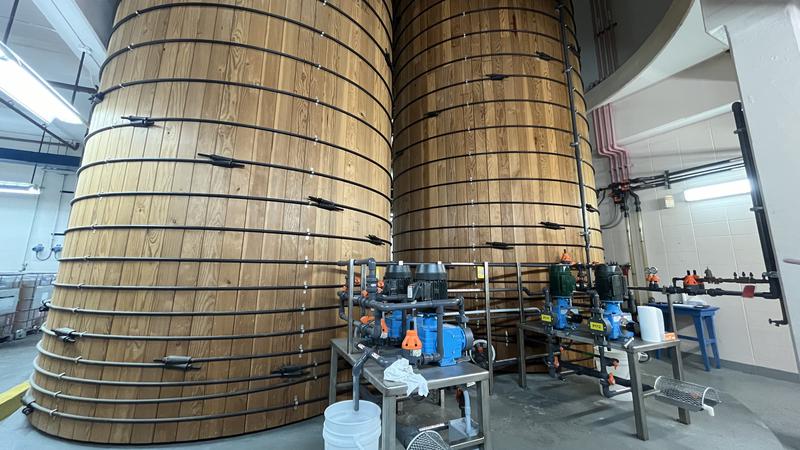
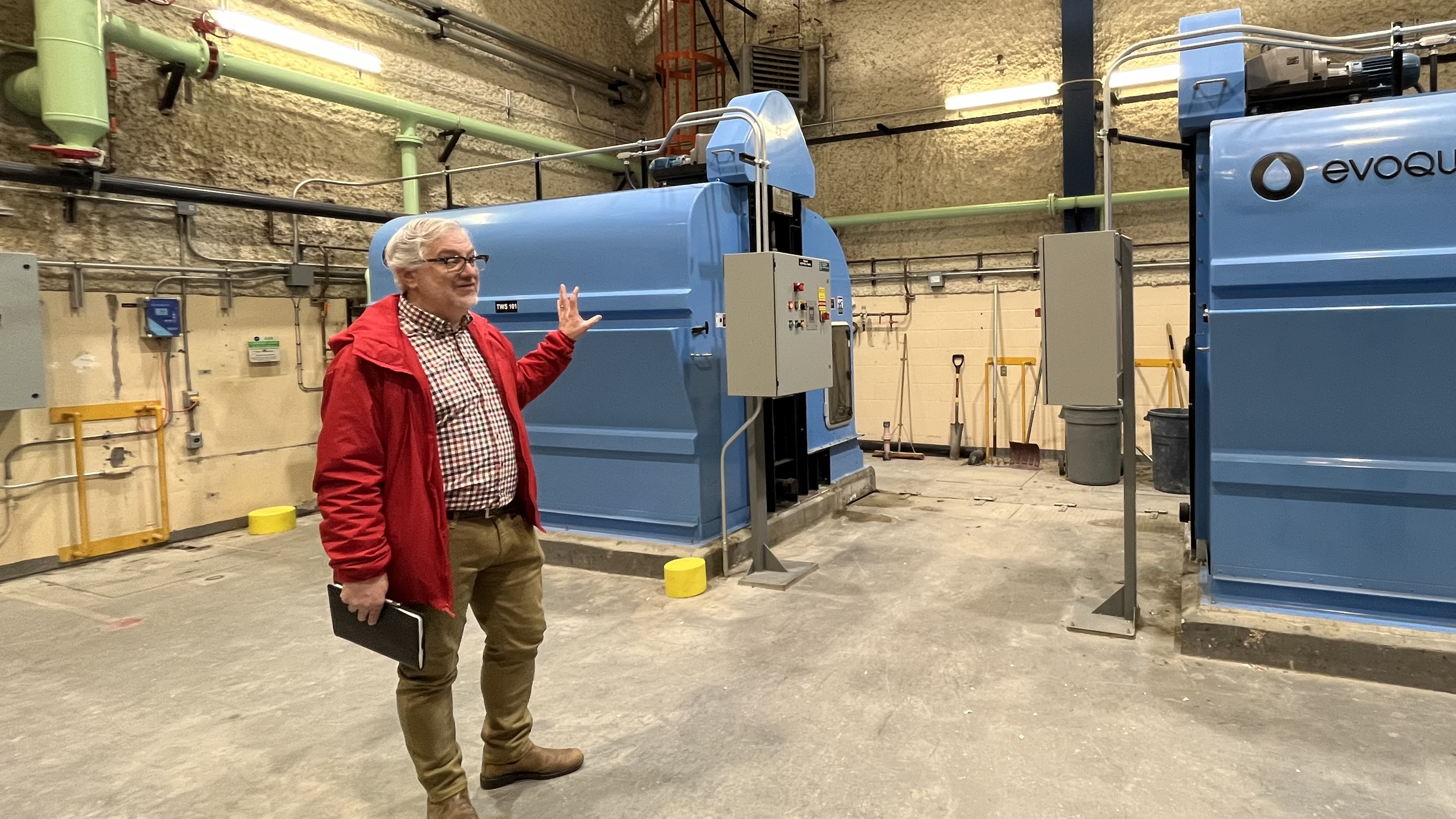
Coagulation tanks at the Lethbridge Water Treatment Plant, February 12, 2024. (Photo: LNN)

Officials call for expansion at Lethbridge Water Treatment Plant

Feb 15, 2024 | 11:43 AM

LETHBRIDGE, AB – The Lethbridge Water Treatment Plant has been a crucial part of the city’s infrastructure for the last four decades.

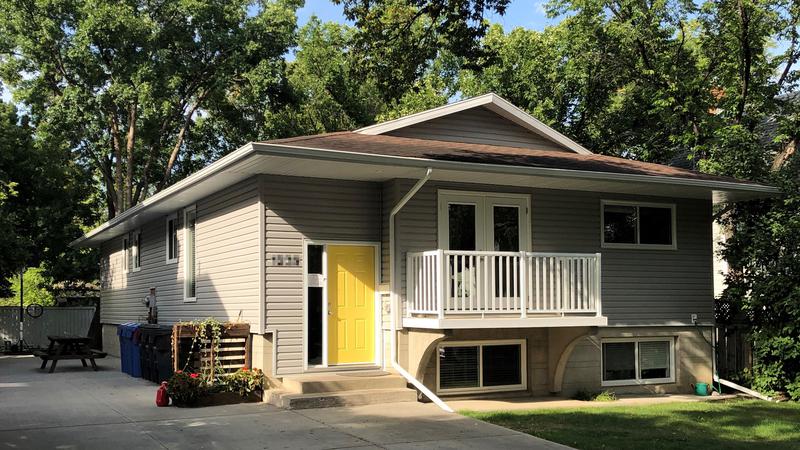
It is currently run by Doug Kaupp, the general manager of water and wastewater for the City of Lethbridge. He offered to take members of the media on a tour of the facility on February 12, 2024.

The plant uses a highly intricate process of moving, filtering and storing water, which it does to approximately 50 million litres every day in the winter.
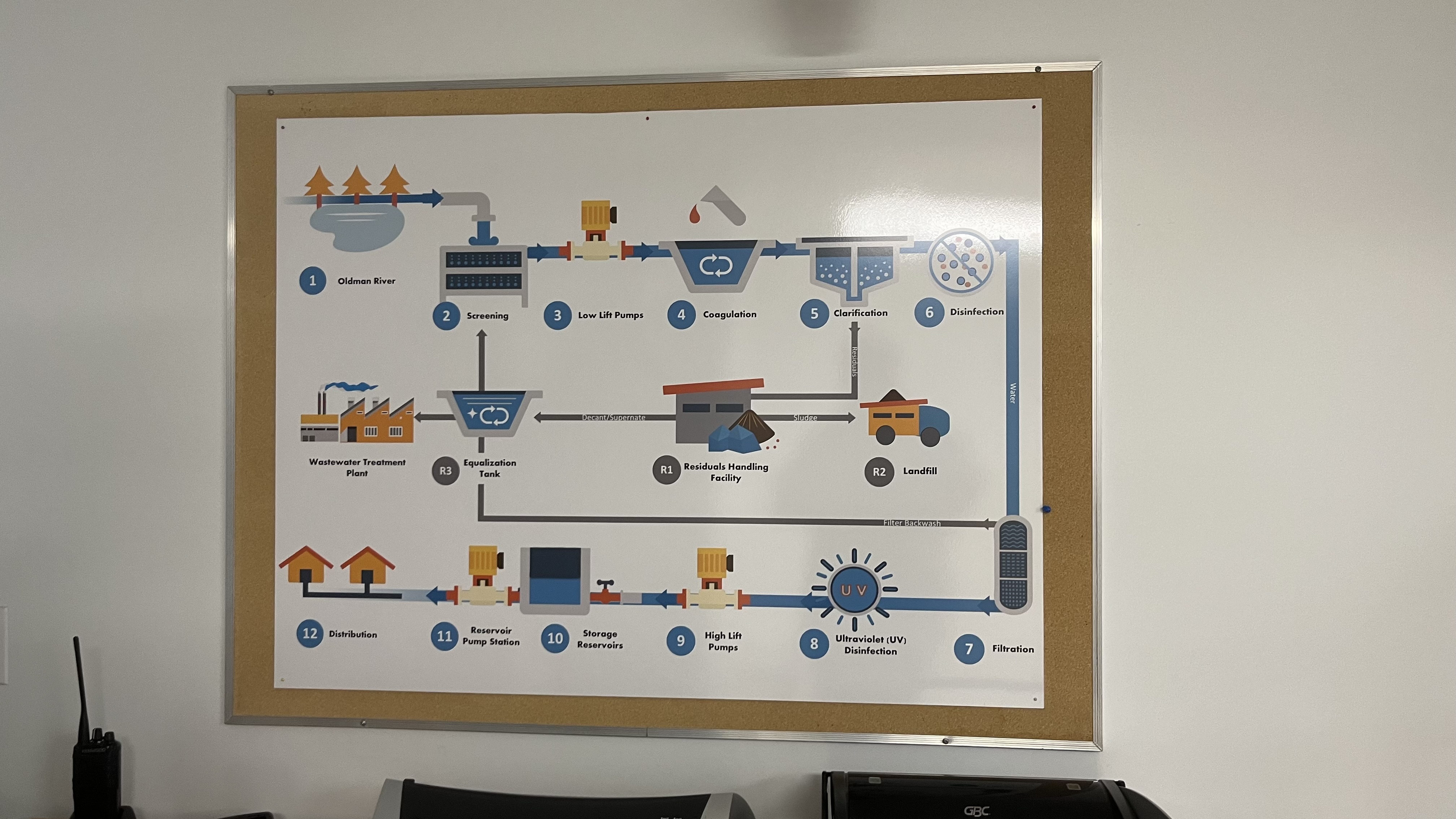
Diagram outlining the treatment process of water in Lethbridge, February 12, 2024. (Photo: LNN)
First, the water is collected from the Oldman River. The next step is for the water to pass through large tanks with screens, which help in separating the water from any larger dirt or debris.

Doug Kaupp, general manager of water and wastewater for the City of Lethbridge at the Water Treatment Plant, February 12, 2024. (Photo: LNN)

After the larger issues are dealt with, chemicals are added to the water, in a process called coagulation, which is when a liquid is changed to a solid or semi-solid state.

Polyaluminium chloride is the main chemical used in the coagulation process. It is then pumped upward for further treatment in clarifiers.

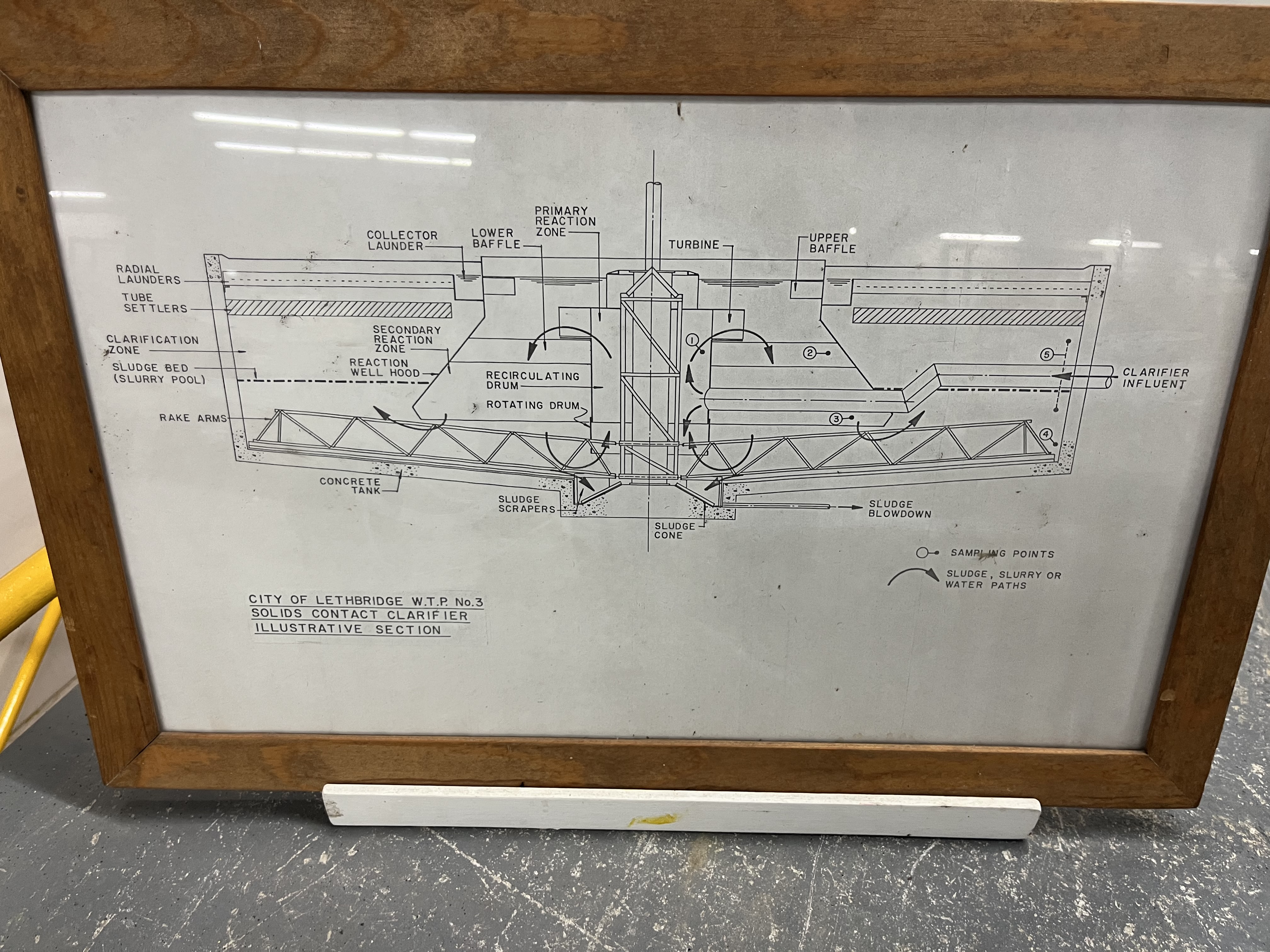
The river water comes out in the centre of the clarifier where it mixes.

Kaupp explained the process, “That stirring in the middle, the technical term is flocculation, and what we’re doing is we’re taking the small particles, and giving them lots of chances to collide and form bigger ones that you can actually see that are no longer just smoke in the water.”

“Those particles, that chemical sludge settles off to the bottom then the water that comes off the top is the clarified water.”

A clarifier seen at the Water Treatment Plant in Lethbridge, February 12, 2024. (Photo: LNN)
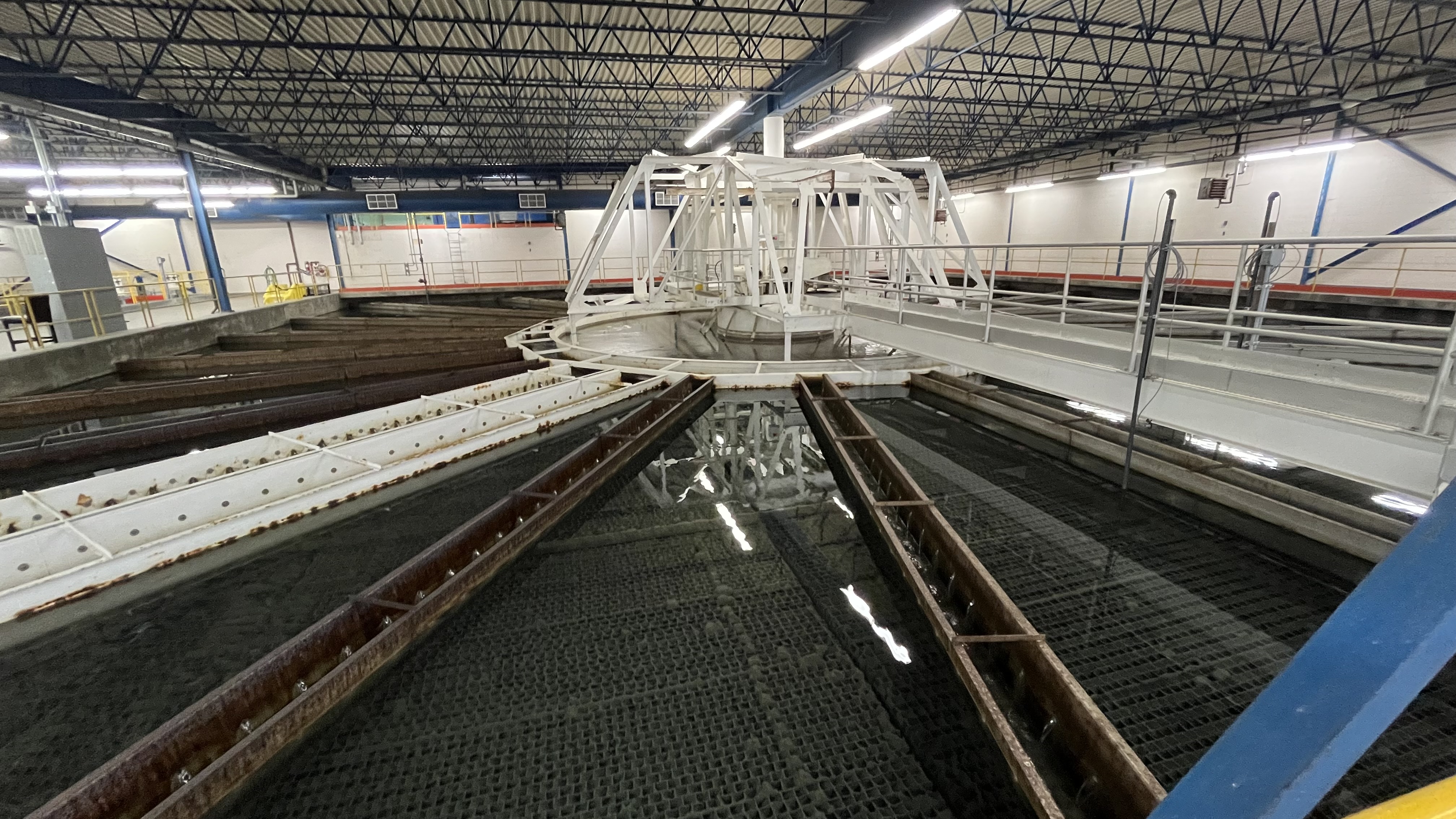
Diagram explaining the process of the clarifiers at the Water Treatment Plant, February 12, 2024. (Photo: LNN)

From the clarifiers, all the residuals (mud, chemicals, dirty water) go into another plant to be processed and dewatered. The muck goes to a landfill while the remaining water gets recycled to the head of the plant to be treated again.

Before the water heads to the filters, potential diseases need to be removed. To do so, chlorine is added to the water to deal with issues like hepatitis and polio. For the more complex, multi-cell organisms, ultraviolet lights are used. However, before that can happen, the water must be filtered.

The filters have sand at the bottom and anthracite (a type of coal) on top. Kaupp said this is done because the sand is dense, heavy and small, while the anthracite is lighter and has larger particles. This way, he noted that the bigger particles are filtered out at the top, and as the water reaches the sand, the finer particles also get filtered out.

After the ultraviolet disinfection, the water is pumped to storage reservoirs where it can be pumped out for distribution.

The plant averages about 60 million litres each day. In the summer, some times that amount can exceed 130 million, with maximum capacity at 150 million.

NEARING CAPACITY

Kaupp expressed the need for larger facilities, for both population growth and water level purposes.

He said, “This plant that was built 40 years ago is approaching its capacity.”

“Our community has grown a lot since 1980. We now have regional customers and new big industries and with hot dry summers, we’ve been setting record maximum day demands, so we do have capital plans to expand the facility in the next five to 10 years to position ourselves to be able to grow more as a community.”

Kaupp continued, “The storage reservoirs are as low as I’ve seen them in 30 years and currently, the snowpack is well below normal. So the stage is really being set for some kind of drought response. So stay tuned, we’ll probably be priding ourselves in brown lawns and dirty cars.”

He provided some ways to cut down on non-essential water usage.

Kaupp said, “All outdoor use is pretty easy to curtail. So lawn watering and washing driveways and car washing and that sort of thing. But inside your home, making sure your washing machine and dishwasher are full before you run it so that in a given week there’s fewer runs, shorter showers, that kind of stuff.”

He hopes to have a larger plant within the next 10 years.

Kaupp stated, “We have expansion plans in a couple of phases.”

“The first phase would be to add 30 million liters of capacity to the plant. So, go from 150 to 180, and depending on the pace of growth, that could last for a decade or two before we go into the next phase. We do have conceptual plans that would get us to over 200, 250 liters a day ultimately.”

READ MORE: Lethbridge News Now.

If you have a news tip, question or concern, please email Lethbridge.newsroom@Pattisonmedia.com.