Stay informed with the LNN Daily Newsletter
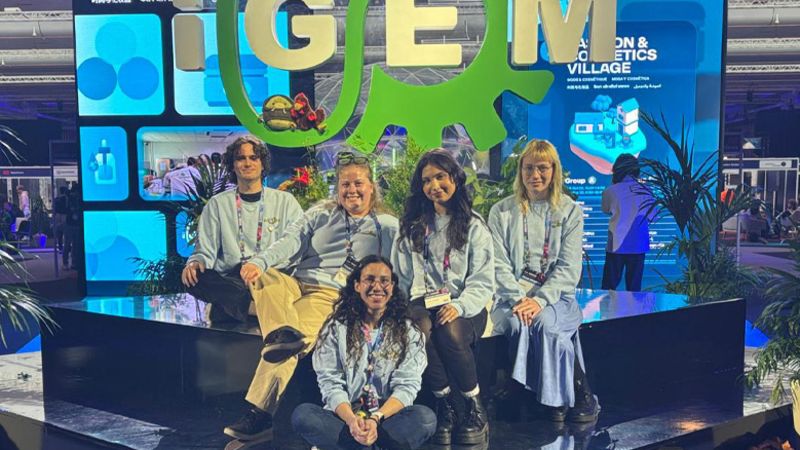
The ULethbridge iGEM group that travelled to Paris included, from left to right: Odin Schaefer, Abigail Giacchetta, Tarlan Goharian, Sonia Ahuja and Sabrina Werner. (Photo: U of L)

U of L genome machine earns silver medal at international competition

Dec 11, 2025 | 2:24 PM

What was originally meant for an entirely different purpose could have some major implications to the scientific community.

The University of Lethbridge (U of L) has announced that a group of students has won a silver medal at the 2025 Grand Jamboree in Paris for their International Genetically Engineered Machine (iGEM).

It started as a project designed to create an efficient and ethical method for hyaluronic acid production, which is utilized by the cosmetics industry.

Abby Giacchetta, a third-year neuroscience student and team member, says that as they progressed, a new focus emerged.


“We needed a way to make the hyaluronic acid, and we wanted to use E coli by mixing genes into its plasmid to spur the production of a hyaluronic acid biofilm,” she says. “To do that, we needed access to a multiplex automated genome engineering (MAGE) machine that is worth about $90,000 — and we didn’t have that kind of money.”

Their solution was OSAGE, or open-source automated genome engineering, which Giacchetta says was designed to use cheap and easily accessible parts online and 3D printed pieces.

The students were not able to pursue both projects at the same time, so they decided to focus on refining their OSAGE machine.

In true iGEM spirit, the group of 16 students plus supervisor Dr. Laura Keffer-Wilkes, built off previous work from the iGEM community in designing their prototype.

“One of the great things about iGEM is that it is open source, meaning everyone has access to all the great work that’s been done in previous years,” says Keffer-Wilkes. “They chose to build off of previous work to create a system that could then be utilized by future generations of iGEM students for their projects, as it basically allows you to create any kind of bacterial strain you want to engineer.”

Rather than cost $90,000, OSAGE can be built for under $1,000.

The judges at the World Jamboree were impressed with the concept, netting them a silver medal. Many indicated that they liked the idea of expanding on past projects and continuing the strong science done before them.

The U of L team is now looking to add members from across fields of study.

The team is currently taking applications for its 2026 cycle. Interested students should check the iGEM web page and contact kefferwilkesl@uleth.ca.