
Stay informed with the LNN Daily Newsletter
U of L graduate student Sara Citron led an international study into an extinct species of bird. (Image Credit: U of L)

U of L student leads international study into extinct bird

Feb 3, 2026 | 3:40 PM

A graduate student at the University of Lethbridge played a key role in studying the unique ways lifeforms evolve.

Sara Citron led an international team from Canada, the U.S., and Australia to look into how an extinct Hawaiian ibis evolved unusually small eyes and a dramatically reduced visual system.

She explains that they made the discovery while examining the skull of an Apteribis, a flightless bird that once inhabited the Pacific islands.

“Anyone who has spent time birdwatching or visiting a zoo is familiar with ibises. These are very distinct birds: they have exceptionally long, elegant beaks and many of them have striking colors that set them apart from other shorebirds,” says Citron. “Their elongated beaks are key to how they feed. By inserting the beak into mud, shallow water, or soft ground, they probe for subtle vibrations that reveal the presence of hidden prey, such as small invertebrates.”
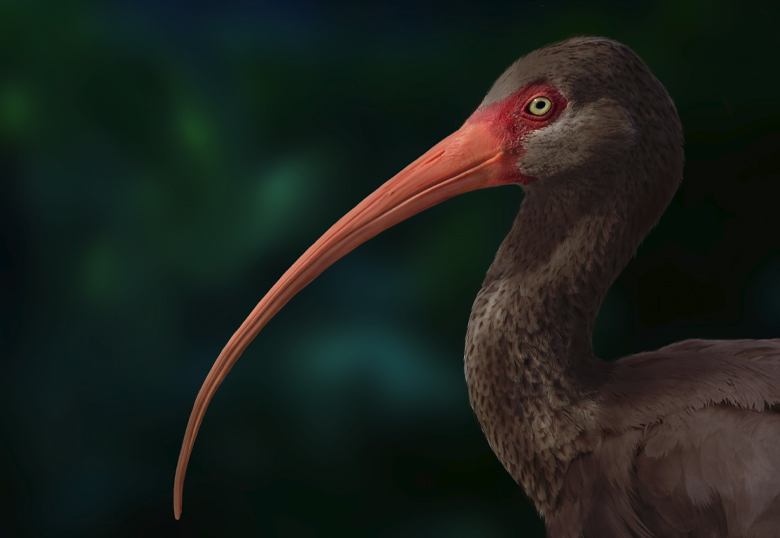
Apteribis, the extinct species that was examined in this study.
Apteribis, the extinct species that was examined in this study. (Image Credit: U of L)

Dr. Andrew Iwaniuk, Citron’s supervisor, says they examined the Hawaiian species because island evolution often produces bizarre anatomies.

The team studied skulls from 25 of the 28 living ibis species, using museum specimens from around the world. With advanced imaging technology, they created 3D reconstructions of the birds’ brains and compared them with those of the fossil species.

“What we found was astonishing,” says Citron. “The eyes and all parts of the visual system that we can measure from the skull were dramatically reduced in Apteribis compared to its living relatives.”

Co‑author Aubrey Keirnan, a PhD student at Australia’s Flinders University, says that such extreme reductions in vision are known only in a few birds, including the New Zealand kiwi and the world’s two nocturnal parrots, the critically endangered kākāpō and the elusive night parrot.

Iwaniuk adds that there are broader implications for this discovery.

“The New Zealand Kiwi is often seen as a one‑of‑a‑kind oddity among modern birds, but this extinct ibis shows that similar forms evolved elsewhere,” he says. “It reminds us how much diversity has been lost, and how many ecological roles disappeared, before we ever had the chance to study them.”

The study can be viewed online here.