Stay informed with the LNN Daily Newsletter
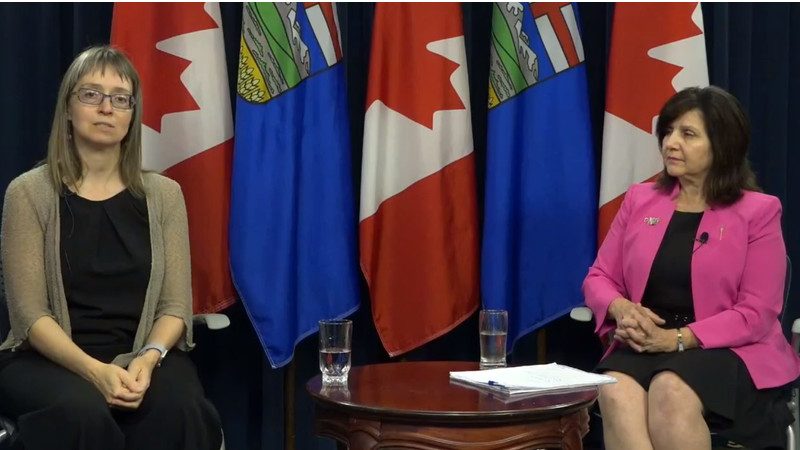
Dr Deena Hinshaw and Minister Adriana LaGrange hold an online Q&A session Tuesday evening to discuss the back-to-school plan (Facebook / Government of Alberta)
BACK TO SCHOOL PLAN

Hinshaw, LaGrange answer public’s questions on return to school plans

Jul 30, 2020 | 10:34 AM

Alberta’s Chief Medical Officer of Health Dr. Deena Hinshaw and Education Minister Adriana LaGrange held a Q&A session Tuesday evening to answer questions and address concerns from the public over the plan to have kids return to school in September.

The province is planning on following the Scenario 1 model of having kids back in classrooms with enhanced health and hygiene measures in place. Hinshaw said the Canadian Pediatric Society has stated that a return to school is critical for students’ health as well as their learning.

She said that when school resumes, kids will be kept in cohorts. Outside of schools, cohorts are groups of up to 15 people outside of a household who spend lots of time together. Hinshaw added that if a case does develop within that group, the possible spread of the virus wouldn’t be as widespread as it could be.

“In a school context, the cohort is really the classroom. We also have daycare cohorts and sports team or performance cohorts,” she explained. “The idea being that you try to minimize the total number of people that you’re with and that you’re not always able to maintain that two metres of distance with.”


Hinshaw said school busses will also be considered a cohort with assigned seating in place.

Families will have to assess their personal situations and determine whether it’s in their best interest to allow their kids into additional cohorts, such as sports teams or performance groups.

Hinshaw said that during at least the first few weeks of school, families will also have to assess whether they are comfortable with visiting family members who may be more vulnerable, such as those with health conditions or grandparents.

Hinshaw adds that, if a case does show up in a class, like it did on Tuesday at a summer school in Calgary, they will have a “rapid response” that will include identifying the contacts of the individual, testing those people, and will be issuing 14-day quarantines.

If a case is identified in a school, those who have come in direct contact with that individual will have to go into direct quarantine. However, Hinshaw said the contacts of the infected individual won’t necessarily need to be quarantined.

In response to a question about whether schools will see an increase in funding to help pay for following COVID-19 guidelines, LaGrange said $120 million is being allocated from the upcoming 2020-21 school year budget, and that the province has accelerated $250 million for capital infrastructure maintenance and renewal.

LaGrange says close to $15 million will be spent on COVID-19 related items, such as touchless sinks and hand-sanitizing stations. LaGrange also noted around $363 million in school board reserves are accessible to school divisions.

While Hinshaw has touted the importance of wearing masks in indoor public spaces, the province’s school re-entry plan does not make wearing them mandatory. Hinshaw said they’ve been evaluating evidence on masks, particularly in schools, and will continue to watch for more evidence before deciding to incorporate mandatory mask-wearing into the plan.

When classes resume in the fall, children with pre-existing conditions that are similar to COVID-19 symptoms – such as runny nose or scratchy throats from allergies, or breathing troubles and coughs from asthma – will be tested at the beginning of the school year. Hinshaw said if a test comes back negative then that child’s condition will be used as a baseline, and if there are no changes to the symptoms they will be allowed to attend class.

“If there is a change, and this a part of the return to school plan, that every morning parents assess their child’s health before taking them to school. And if there is a change, if they have more of a cough, if they have a fever, if their runny nose has progressed from a little bit of irritation that they always have to having a lot of congestion, then that’s when we’re really relying on parents, who know their children better than anyone, to assess ‘Is this new? Is this different?’ And if yes, then at that point we would ask that they stay home and be tested again.”

Hinshaw said government and AHS are working towards creating a more streamlined process for administering and getting the results of COVID-19 tests, though she could not offer a timeline for how soon they will be readily available for more widespread use.

The return to school guidelines set out by the province does have the option of going from Scenario 1 to Scenario 2, which see have fewer students in school at one time and move to more online learning, as well as to Scenario 3, which is a return to at-home learning. The need to change from one scenario to another would depend on the situation in the local community, and any plans to change would be determined in conjunction with school divisions, as well as Dr. Hinshaw and her team.

Hinshaw said that based on other jurisdictions around the world that continued with school operations, or are back in class already, having schools open don’t necessarily play a role in creating a COVID-19 outbreak in a community. However, if there is widespread transmission in the community already it could lead to an increase of exposures in the schools.

Both Hinshaw, a mother, and LaGrange, a grandmother, said they feel confident in the plan to return kids to class in a near-normal setting.

(everythingGP)