Stay informed with the LNN Daily Newsletter
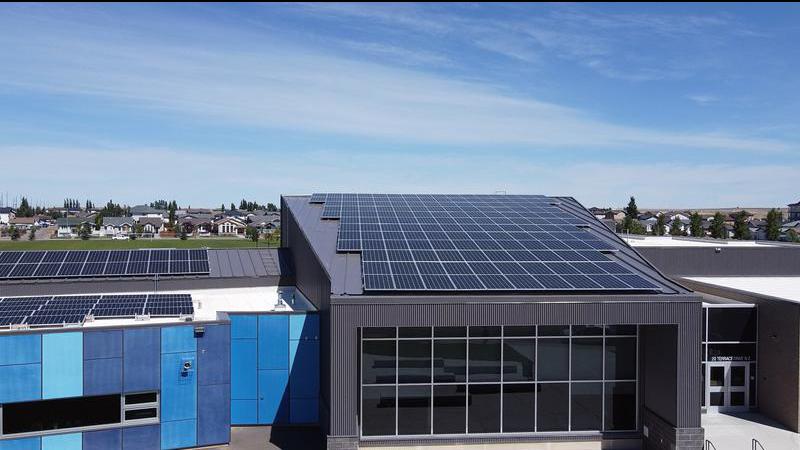
Dr. Ken Sauer Elementary school in Medicine Hat. (CHAT News Today)
$250M INVESTMENT COULD CREATE 12,000 JOBS

Alberta’s small-scale solar industry seeking $250-million from province

Aug 11, 2020 | 10:17 AM

MEDICINE HAT, AB – Alberta’s solar industry is lobbying the provincial government for a $250-million investment for residential, commercial and agricultural micro-generation projects to be part of the $10 billion provincial stimulus package announced in June.

Marcus Campbell, Owner of Medicine Hat-based solar installer Terralta, says the double whammy of the economic impacts of COVID-19 and the ending of incentives for small-scale solar electricity generation projects has hit the industry. It’s a situation that can be turned around almost overnight if the province renews its solar incentive program brought in under the former NDP government.

“We know solar energy is on their radar,” said Campbell of the province’s position. “And if they make this $250 million investment, we believe that will equal approximately 12,000 jobs in the province of Alberta.”

That investment would leverage $750 million in private investment from farmers, homeowners, and businesses.


As far as criticisms of subsidizing the solar industry, Campbell says the sector is not asking for anything which other energy producers are already receiving in terms of public funds.

“The oil and gas industry gets subsidized all the time. Everybody thinks that solar energy is the only industry that gets subsidized. All energy industries are subsidized.”

He stressed it’s not an either/or argument, saying both co-exist and stating it would be hard to find a pumpjack without a solar panel on it somewhere.

Benjamin Thibault, executive director of advocacy group Solar Alberta, adds that small-scale solar electricity production saw exponential growth over the last decade and, “in the last five years, that has gone up over ten-fold and we’re now at almost 80 megawatts of micro-gen(eration).”

With the loss of incentives, however, including those for agricultural producers initiated by former PC premier Ed Stelmach, Thibault believes the industry is a risk of stagnating.

“It’s in that space that we are seeing the provincial government decision making allowing that sector to whither on the vine, which is really unfortunate because it’s particularly neat how solar is able to bring consumers into producing energy and that’s what’s getting left behind at the moment.”

As for critics of solar energy, Campbell says he has more than a decade of generation data for southeastern Alberta showing it’s viable and, “if anybody wants to come by and see our data, come on by, we’ll show you.”