Stay informed with the LNN Daily Newsletter
SpearChief-Morris (centre) competing at the FISU World University Games in Napoli, Italy in 2019 (Photo credit: Mathieu Belanger)

Lethbridge-born hurdler pursuing Olympic dream

May 2, 2021 | 8:15 AM

LETHBRIDGE, AB – The 2020 Summer Olympics in Tokyo have faced many challenges over the last year.

The prime example being the postponement of the Games brought on by the COVID-19 pandemic last summer. As it stands, the Summer Olympics are set to take place from July 23 to August 8 in Tokyo this year.

Athletes have faced uncertainty, as various restrictions have been put in place around the world to help combat the surge of the virus.

One of those athletes is Lethbridge’s Joy SpearChief-Morris, who is training to qualify for the Games in the 100-metre hurdles track and field event.


The Lethbridge Collegiate Institute graduate spoke with Lethbridge News Now about her training, the impacts of the COVID-19 pandemic and how she got into the sport.

She said her practices focus a lot on track work, mixed in with strength training and of course, recovery days.

“I have technical days for hurdles in which I’m doing specific hurdle work, hurdle drills, and you know, doing what I need to do to physically go over the hurdles. I have days where I focus more on short speed and being fast and I have days, where we call them special endurance days, so I’m running longer than 100 metres – up to 200 metres in multiple reps to kind of build endurance.”

In addition, she has specific weight training sessions twice a week. Her recovery days don’t necessarily mean sitting around on the couch, either.

SpearChief-Morris explained that she uses a Peloton bike to keep her legs fresh. She also incorporates yoga into her training, doing a little bit every morning with longer sessions on her recovery days.

Additionally, the 27-year-old has had to battle back from some recent injuries.

“I’ve had some Achilles tendinitis and I had surgery on my wrist about a month ago, so I’ve actually been doing a lot of cross training in the last couple months and have just recently gotten full-time back on the track.”

COVID-19

SpearChief-Morris trains out of London, Ontario and remarked that one of the biggest challenges of being an athlete during the pandemic is the consistent change in health regulations.

She said that, “you’ll just start to get used to a specific routine or something and then that gets blown completely out.”

“We’ve lost facilities. I used to train at Western University [in London], but I actually haven’t been allowed on to a Western track since last March, so we’ve been training at community tracks [and] at local high school tracks.”

Last summer, SpearChief-Morris would have to drive outside of London for practices and she conducted small circuit training exercises in her one-bedroom apartment.

“I had two 25-pound dumbbells and I had some bands, and that was all I had last summer.”

SpearChief-Morris getting set to run at the FISU World University Games in Napoli, Italy in 2019 (Photo credit: Mathieu Belanger)

Over the winter, she explained that her training team was able to use a decommissioned hockey arena to set up a makeshift indoor track setup.

She said, “that gave us about 50 metres of track, so I could get around three to four hurdles in, but it was also freezing cold because it was winter outside.”

“There was no heat and we were also on frozen cement.”

However, the Lethbridge-born athlete realizes she’s lucky to still be training, in whatever way that may be.

“I know some people aren’t as lucky and athletes all around Canada are dealing with different situations.”

BACK ON THE TRACK

On June 4 in Ottawa, SpearChief-Morris will compete in her first meet since early last year.

It will be her first Olympic qualifying event, and she will be kept busy all of June competing in qualifiers.

“I’m in Ottawa, and then I’m in Windsor, then in Toronto, then in Guelph and then I’m hopefully in Montreal, so it’s going to be a very quick back-to-back process.”

SpearChief-Morris said the qualification process has changed over the years, explaining that athletes have to make it on to a world-rankings list.

“To get on to the world ranking list, you have to have at least five times – at least in my case for running – you have to have five times, and those five times at those five meets, based on what time you finished at and where you finished and what the meet was, all qualify into a points system.”

Those earned points put an athlete on to a list with World Athletics (formerly known as the IAAF).

“Then you get that list [and] there’s so many allowed per that list per each event for the Olympics, then that list gets you on an invite and then your country – you’d have to still be top two for your country – then there’s the trials and we just heard the trials may or may not go ahead.”

She added that there’s an automatic standard time as well. If an athlete makes that time at a qualifying event, then they are guaranteed an invitation.

“I believe as long as your county signs you, you’re good to go.”

“I just know I have to have five meets; I need to run very fast at those five meets. I would love to hit the auto standard in which case then I don’t have to stress as much on where my point standing is, then I really just put a lot of trust in my team that they’re helping with doing the math and helping to get me to the right meets and where I need to be.”

GETTING INTO TRACK

SpearChief-Morris said her favourite times in elementary school were track and field days, noting she loved the high jump and relay races.

In middle school, her interest in track meets grew and by high school, she started competing more seriously.

She commented that, “in high school, it became a bigger deal because it was a bigger season and there was the chance to compete provincially.”

“That’s when I started qualifying for provincials. I started doing really well and I kind of figured out toward the end of high school that I was good enough at track to go to university for it.”

After graduating from Lethbridge Collegiate Institute, SpearChief-Morris attended the University of British Columbia, competing for the Thunderbirds in the National Association of Intercollegiate Athletics (NAIA).

She was primarily a 100 and 200-metre runner up until her second year.

That’s when the opportunity to compete in hurdles came knocking, at the suggestion of her coach Derrick Johnston.

SpearChief-Morris said that, “[he] was saying, ‘I think you’d be really good at hurdles’, and I was like, ‘no Derrick, I’m very clumsy, we know this, this would not be a good idea’, and he kept just kind of hinting at it.”

“One day, he just kind of set them out [the hurdles]. It was like a practice over reading break and he was like, ‘just try them’. We kind of tried them and it wasn’t terrible, it wasn’t pretty, but we decided to race them. I fell flat on my face and then we kind of put that aside for a while. I kept being a 100 and 200-metre runner.”

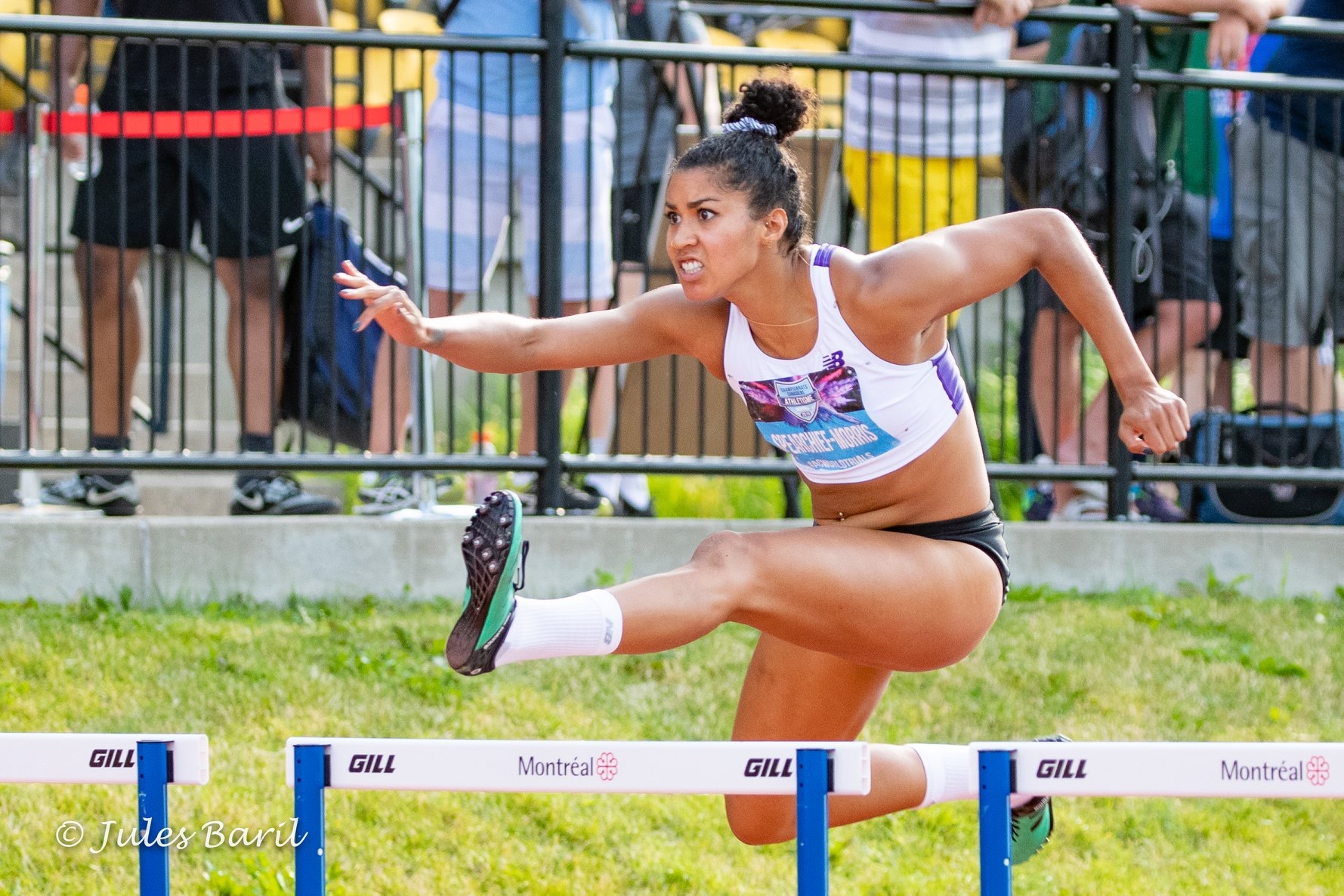
SpearChief-Morris at the Canadian National Championships in 2019 (Photo credit: Jules Baril)

Following her time at UBC, SpearChief-Morris made the move to Ontario and transferred to Western University in London. The key difference was that her new team, the Mustangs, competed under U Sports, as opposed to the NAIA.

The NAIA holds an outdoor track and field season. With the Mustangs and U Sports, SpearChief-Morris would be making a switch to indoor track competitions.

She explained that events are modified from indoor to outdoor because of a smaller track size.

With the shift from the NAIA to U Sports, she was going to run the 60-metre event as opposed to the 100.

Aside from the relay, she had no other option to compete in a 200-metre run, so she could either compete in the 300-metres or give hurdles another shot, which she ended up doing.

“I am very thankful for my whole coaching team for believing I could do hurdles and do them well, and I ended up being the Western record holder in hurdles and [a] multiple national medallist.”

Upon her graduation from Western, she decided to stick with the hurdles on her Olympic pursuit.

COMMUNITY SUPPORT

The Lethbridge hurdler said her parents are her biggest supporters.

“They’ve managed to fly all around the United States and Canada to watch me at certain meets.”

“They’re always live-streaming when I’m competing as well.”

She added she’s always been fortunate to receive support from friends and the entire Lethbridge community throughout her career.

“I have my close high school friends [who] still live in Lethbridge. One of my friends always makes sure that she watches the live-stream when I compete and they’re just always so supportive of everything I do. I’m really grateful to the Lethbridge community for supporting me, even from afar.”

She also received some assistance from members of her hometown Lethbridge community via the Adopt a Mustang program, which allows people to help student-athletes pay for sport fees and services at Western University.

GOING FORWARD

As she continues to train, SpearChief-Morris has learned about the importance of being adaptative and flexible, adjusting to any new COVID-19 restrictions that may come.

She remarked that, “my goals haven’t changed, but I think I have a little bit more peace knowing there’s only so much I can control. If I can’t go to the States doing those high performance meets like I’m normally doing, I have to be able to make the best with the opportunity that I have and know that those are more opportunities than other people have.”

She noted that the pandemic has not been easy, and there have been times where she has questioned whether or not she should keep pursuing her chance to compete in the Olympics.

“You really have to dig down. I’ve spent nine years of my life doing this and at the end, I have to be happy with it in the end with how I’ve done this journey and I think I can say I am. I’m happy with how I’ve done it and where it’s taken me and, in the end, whatever the result is, I’ll be happy with that, too.”