Stay informed with the LNN Daily Newsletter
(ID 13932251 © Gale Verhague | Dreamstime.com)
sunnier days ahead for solar

Red Deer lags behind fellow communities on solar policy, says Solar Alberta report card

Oct 15, 2025 | 10:15 AM

Red Deer recently gets a failing grade in a new report card put out by an organization called Solar Alberta.

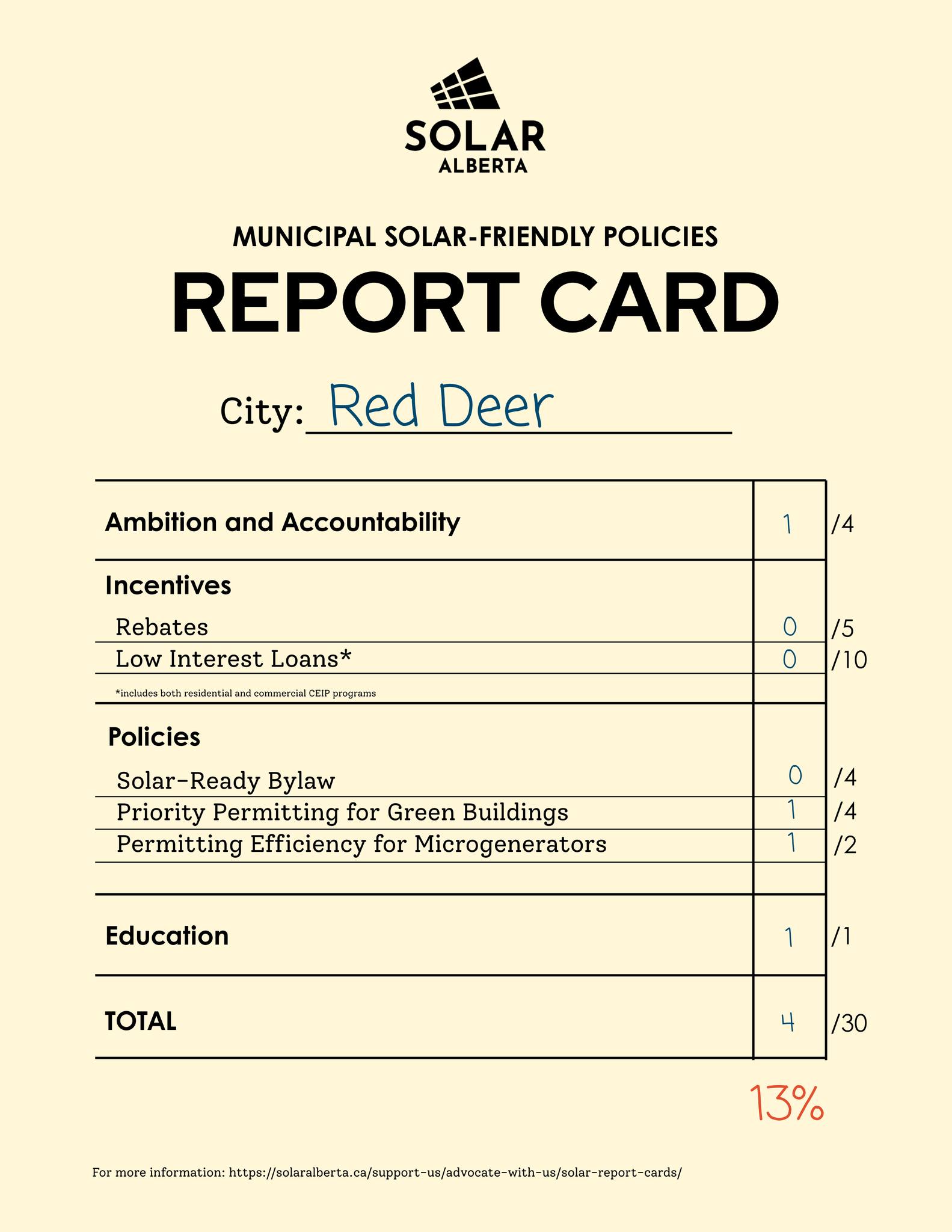
The ‘Municipal Solar-Friendly Polices’ Report Card gives Red Deer a mark of just 13 per cent — already an F, but also well below the rest of the communities assessed.

Edmonton received 67 per cent, Calgary and Banff received 47 per cent, Grande Prairie, St. Albert and Medicine Hat came in at 43 per cent, and Airdrie at 40 per cent, while Lethbridge is at 33 per cent.

A passing mark of 1/1 is given for education, however when it comes to ambition and accountability, municipal incentives, and policies, Solar Alberta says Red Deer just doesn’t pass the smell test.

Speaking with rdnewsNOW, City of Red Deer community development coordinator, Phil Boehme, acknowledged the municipality has room to grow, but thinks the report is missing some context.

“There’s some subjectivity here, especially with the first set of criteria around ambition and accountability. We certainly do have a number of projects that have been completed in the past … we are investigating what has worked well in other municipalities,” he explained.

“Where I say we’re doing some work to assess what would make sense for Red Deer is around demand for incentives to support solar installation. Our microgeneration program does allow people to go through that process.”

According to the city, there are 537 microgeneration sites in operation; these sites aren’t solar projects themselves, but support solar and alternative energy installations.

According to Boehme, Red Deer is currently looking at signing on as a member of the provincial Clean Energy Improvement Program (CEIP) — a financing tool which enables residential and commercial property owners to pay for energy efficiency and renewable energy upgrades. Unlike a traditional loan, ABMunis explains, repayment is facilitated by a tax added to one’s property tax bill.

As pointed out by Heather MacKenzie, executive director of Solar Alberta, the CEIP is a prime example of Red Deer’s political leadership falling short.

According to the Alberta Municipalities website, 29 communities have passed clean energy improvement tax bylaws, and there are 26 with active programs.

Devon was the first to sign up in 2019, followed by places like Rocky Mountain House, Canmore, St. Albert*, Lethbridge*, Edmonton*, Grande Prairie*, Calgary*, Banff*, Medicine Hat*, Stettler, Spruce Grove and Airdrie*.

Municipalities with an asterisk (above) make up the rest of the communities Solar Alberta assessed, meaning Red Deer is the solitary one without a clean energy improvement program.

“We’re not trying to be judgmental or harsh to administrators. A lot of the initiatives we’re critiquing require leadership from politicians. The Clean Energy Improvement Program can only be put in place if elected officials adopt a clean energy improvement bylaw. Administrators can’t just up and do it,” says MacKenzie, who admits the timing of their report cards, close to the municipal election, was intentional.

“Our hope is the new council will adopt the program, just as others have. To anyone who wants to say, ‘Edmonton and Calgary have more capacity than we do,’ then why does the town of Devon have it, or Taber, or the Village of Stirling? We want politicians to take note of the role they have to play in this.”

Adding more context, the city of Red Deer says current and future green energy-related (not specifically solar) initiatives include:

  • Environmental Master Plan: We remain committed to implementing The City’s Environmental Master Plan, which guides efforts to reduce energy use and environmental impacts. Resources are available for businesses and organizations, including energy efficiency and renewable energy alternatives.
  • Resident Rebates: While Red Deer does not currently offer solar rebates, we provide rebates for small but meaningful energy efficiency upgrades, such as smart thermostats, water timers, and rain barrels.
  • Microgeneration: Red Deer’s application and interconnection processes ensure compliance with the Electric Utilities Act and the Microgeneration Regulation to support solar and alternative energy installations. The 537 microgeneration sites in operation represent 6,729 kW AC capacity installed (511 residential and 20 commercial). More information is available through our Electric Light & Power Microgeneration Program.

The City of Red Deer says it ensures all solar installations meet required standards under Alberta’s Safety Codes Act. Inspectors verify permit compliance with the applicable codes to ensure safety and reliability. More information can be found here.

There are over 38,000 Albertan homes and businesses with solar, and 1,000 more coming on board monthly, MacKenzie notes.

Asked if he could see Red Deer getting an improved grade in a few years from now, Boehme says assuredly, yes.

“Red Deer will be in a different position, as technology advances and as the city continues to support where there’s interest and need for more solar,” he says. “I think once we get energy diversification and the innovation strategy completed, we’ll have a better sense, whether it’s toward more solar or other things.”

Meantime, MacKenzie and Solar Alberta, which is a small non-profit that’s been around since 1991, admit there can be some sticker shock for folks exploring installation of solar panels, even if it means they’re going to save money in the long run, and that they’ll last 40 years.

A 2023/24 provincial government moratorium on large solar farms and wind farms didn’t help matters, she says.

“What we saw at the same time was really massive growth in rooftop solar adoption. The moratorium was negative, it put a chill on investment in large solar projects, but every day Albertans have continued to invest in solar at alarming rates.”

Five years ago, it was just 100 new homes every month, compared to the 1,000 now.

“Even though there’s been a chill on investor confidence in this sector at a large scale because of the decisions the province has made around discriminatory regulation, at the grassroots, I would say Albertans are still really excited about solar,” MacKenzie continues.

“They know we’re a very sunny province and they want to see the financial benefits. Most Albertans see Alberta as an energy superpower and they just see solar as a natural part of that mix.”

Lethbridge, MacKenzie notes, is part of a zone in Alberta’s southeast, which gets the most sunlight in Canada, according to a publicly accessible photovoltaic and solar resource map the Government of Canada maintains.

Red Deer and Calgary are in the next zone with Edmonton, so Alberta is just brimming with potential for harnessing the power of the sun, MacKenzie insists.

Notably, Efficiency Canada put out its own scorecard in 2024, grading provinces and the Yukon on 45 metrics related to energy efficiency policies and programs, buildings, transportation and industry.

Alberta placed dead last; MacKenzie notes it’s a relevant report, but adds it doesn’t solely look at solar.

MacKenzie said finally that Solar Alberta hopes to get to the point where it can issue a report card every year.

The 2025 study was conducted by University of Calgary Capstone project student Yiming (Sebastian) Hu, who did the research as part of his Master’s Degree. The work included contacting each municipality, which had the chance to confirm or refute any assessment details.